REVIEW · AUSTIN
Double Decker Austin Single Loop Sightseeing Tour
Book on Viator →Operated by Double Decker Austin Tours · Bookable on Viator
Austin in one loop sounds almost too easy. This double-decker ride packs a lot of downtown landmarks into about 75–90 minutes with live guide talk and great photo angles from the top deck. I love the choice of open-air upstairs for skyline shots or the climate-controlled lower deck when the weather is doing its thing. I also like how the route helps you get your bearings fast—you’re not guessing where everything is.
One thing to consider: it’s a designed highlight loop, not a deep, neighborhood-by-neighborhood walking tour. If you’re hoping for a slow, stop-to-read kind of experience, or you want every corner of Austin covered, you may feel like you’re seeing the headlines.
In This Review
- Key Highlights You’ll Actually Notice
- Austin Visitor Center Start: the Fast Way to Get Oriented
- Double-Decker Seating: Top Deck Photos vs Lower Deck Comfort
- The 75–90 Minute Downtown Loop: What You’ll See and Why It Works
- 6th Street, the Austin Convention Center, and the Fire Museum Stop You’ll Remember
- A Preserved 1869 Home That Connects Austin to Big Texas Turning Points
- William Sydney Porter and the Driskill Hotel: Austin’s Literary and Architectural Side
- Texas State Capitol and the Governor’s Mansion: Why These Stops Matter
- LBJ, UT Landmarks, and the Stadium: Big Names, Quick Orientation
- Museum Pass-By Stops: Bullock, Blanton, and the Ransom Center
- Congress Avenue Bridge Bats and South Congress: Two Austin Icons in One Stretch
- Where the Time Really Adds Value (and Where You May Want More)
- Who This Tour Fits Best
- Should You Book the Double Decker Austin Single Loop?
- FAQ
- How long is the Double Decker Austin Single Loop Sightseeing Tour?
- Where does the tour start and where do you end?
- How much does it cost per person?
- Is the tour offered in English?
- What are the seating options on the bus?
- Do I need printed tickets?
- Is the tour weather dependent?
- Are there any restrictions on animals or group size?
Key Highlights You’ll Actually Notice

- Open-air top deck for skyline and street-scene photos without juggling walking routes
- Live guide commentary that turns landmarks into stories (not just stop names)
- A downtown-focused loop that’s ideal for your first day or a tight schedule
- A mix of iconic sites and classic Austin history, from the Capitol to firehouse-era artifacts
- Seasonal bat viewing potential on Congress Avenue Bridge (April–October is best)
- Small-group feel with a maximum of 35 travelers
Austin Visitor Center Start: the Fast Way to Get Oriented

Your tour starts at the Austin Visitor Center area on Red River Street, between 4th and 5th (the posted start is 103 E 5th St.). This is a smart location because it’s right where most downtown sightseeing and parking options already funnel people.
You’ll board the double-decker and loop through the city’s core, then end back at the same meeting point. That “back to start” setup matters: it keeps the rest of your day simple, especially if you want to walk to a museum, grab lunch, or continue with other plans.
You can also read our reviews of more tours and experiences in Austin.



Double-Decker Seating: Top Deck Photos vs Lower Deck Comfort
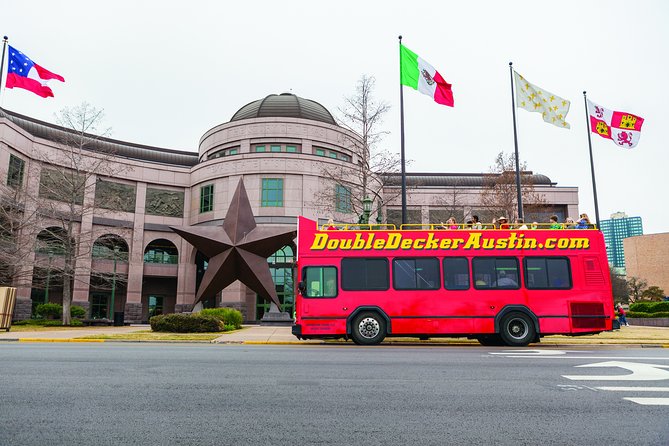
The big practical win here is that you can pick your ride style. Upstairs is open-air, so you get that unobstructed “look around” feeling for photos and quick landmark spotting. Downstairs is climate-controlled, which is a relief when it’s hot, breezy, or if you’d rather not manage the sun and wind.
The top deck does come with one real-world heads-up: you may need to duck sometimes, since parts of downtown have low tree limbs. It’s not a deal-breaker, but it’s worth knowing so you don’t go in expecting a totally hands-free view.
The 75–90 Minute Downtown Loop: What You’ll See and Why It Works
This tour is built for time. At roughly 1 hour 15 minutes to 1 hour 30 minutes, you get a high-density pass through Austin’s best-known sights without spending your day navigating traffic or searching for parking. The loop format also helps if you’re arriving from somewhere else and need a quick orientation.
At $36.81 per person, the value comes from two places:
1) You’re buying a shortcut around downtime—less time figuring out logistics, more time seeing landmarks.
2) You’re paying for narration—live commentary turns “a building” into “why it matters,” so you can decide what’s worth returning to later.
Also, the group size caps at 35, so it doesn’t feel like a chaotic cattle-car situation.
6th Street, the Austin Convention Center, and the Fire Museum Stop You’ll Remember
The tour hits the Historic 6th Street Entertainment District, a key Austin zone. Even if you’re not there for nightlife, this is one of the best places to understand how Austin’s downtown energy works—what’s walkable, what’s near other attractions, and what kind of scene people come for.
Next you roll past the Austin Convention Center, which helps set the geography. Even if you don’t go inside, you’ll start placing nearby landmarks in context for the rest of your trip.
Then comes the Austin Fire Museum, located in the historic Central Fire Station No. 1. This is a standout stop type because it’s not just “famous building” sightseeing. It connects you to how the city’s public safety story evolved across the 19th to 21st centuries, with uniforms, photos, and memorabilia. If you like museums that feel local rather than generic, this one hits.
A Preserved 1869 Home That Connects Austin to Big Texas Turning Points
One of the tour’s more story-driven moments is the preserved 1869 home of Joseph and Susanna Dickinson Hannig. This isn’t just architecture. It’s a Texas timeline in house form.
Here’s the connection the guide-style narration points you toward: Susanna Dickinson survived the Battle of the Alamo and carried news of its fall to Sam Houston. That chain of events is tied to the Battle of San Jacinto, which played a role in Texas independence. In a short bus loop, it’s a lot of weight to pack into one moment, and that’s why it stands out.
This stop also gives you something practical: it helps you see downtown as a layer-cake of eras, not just modern streets.




William Sydney Porter and the Driskill Hotel: Austin’s Literary and Architectural Side
After the Hannig home, you’ll get a pass through William Sydney Porter’s life in Austin, with the chance to look inside (as described for the site on the route). This is a nice contrast after political and military history—Porter’s story adds a creative thread that makes Austin feel more than just a set of monuments.
Then you reach the Driskill Hotel, a Romanesque-style building completed in 1886. It’s also noted as the oldest operating hotel in Austin, and that single fact explains why it keeps showing up in photos and stories about the city. It’s the kind of landmark you’ll probably see again later—once you know it, you’ll recognize it around downtown.
Texas State Capitol and the Governor’s Mansion: Why These Stops Matter

When the bus reaches the Texas State Capitol, you’ll understand why it’s treated like Austin’s centerpiece. The Capitol is described as one of the most distinguished state capitols, and it carries historic recognition including placement on the National Register of Historic Places and designation as a National Historic Landmark. Even if you don’t go inside, just seeing it from the route helps you frame where downtown civic power lives.
Right after that, you’ll pass by the Texas Governor’s Mansion, the official residence since 1856. The tour context is helpful here: it’s described as the fourth oldest continuously occupied governor’s residence in the country, and the oldest governor’s mansion west of the Mississippi River. That’s a big “how long has this role existed” clue—Austin has roots that run deep.
There’s also an important modern chapter: the Mansion was severely damaged by arson on June 8, 2008, then restored and set to continue as the official residence. This is one of those moments where a short bus stop still gives you real emotional context, because it includes the loss and recovery, not just the shiny exterior.
LBJ, UT Landmarks, and the Stadium: Big Names, Quick Orientation
The route continues into the world of Texas politics and education with stops that function like landmarks on a map.
You’ll pass the Lyndon Baines Johnson Library and Museum, with its message about telling the full story: facts alongside triumphs, and also failures and sorrow. Even if you only see it from the route, it helps explain why LBJ remains so tied to Austin’s identity.
Then you roll past Darrell K Royal–Texas Memorial Stadium, home of the Longhorns since 1924. The tour notes include earlier seating capacity details (100,119) and its ranking at the time. For visitors, the main value is simple: you’ll connect Austin to college sports culture, and you’ll know where the stadium sits relative to other downtown sights.
You’ll also see the UT Austin Tower, completed in 1937 at 307 feet. This is one of those landmarks that makes it easier to navigate later, because it’s a tall “pointing finger” you’ll spot from far away.
Museum Pass-By Stops: Bullock, Blanton, and the Ransom Center
A lot of bus tours either focus only on big exteriors or send you to shopping zones. This one includes major museum stops along the route, which helps you plan follow-up time.
You’ll pass the Bullock Texas State History Museum, described as opening in 2001 as the official history museum of the state. Then there’s the Blanton Museum of Art, noted for more than 19,000 works and rotating exhibitions. If you’re an art lover, you’ll appreciate seeing these names because it makes “what should I do tomorrow?” easier.
The Harry Ransom Center also appears on the route, described as a research center at UT Austin with deep collections tied to literature, photography, film, art, and the performing arts. This is the kind of stop that’s less about a quick photo and more about discovering what kind of museum day you might want next.
Congress Avenue Bridge Bats and South Congress: Two Austin Icons in One Stretch
One of the most memorable elements of the route is Congress Avenue Bridge, known for the largest urban bat colony in North America. The tour info shares the scale—between 750,000 and 1.5 million bats—and it specifies that bats fly out near dusk, with best viewing April–October.
Here’s the practical version for your planning: if your tour timing lands near dusk in those months, you might catch the early action from the bridge area. If it doesn’t, you’ll still get the key landmark in place, and you’ll know exactly where to return when conditions are right.
After that, you’ll hit South Congress (SoCo), described as a must-stroll area south of Lady Bird Lake and a popular local hangout. This is where Austin’s older personality and street-level retail and food culture overlap. Even without stepping off the bus, it helps you understand that SoCo isn’t random—it’s a district you can build a whole afternoon around.
You’ll also pass the Long Center, which is tied to performances, music, movies, festivals, and other community events. If you’re the kind of traveler who likes catching one local show, this stop gives you a name to chase.
Where the Time Really Adds Value (and Where You May Want More)
This tour shines if your goal is to build an Austin “menu” quickly. You’ll see the Capitol, the Governor’s Mansion, museum-heavy UT territory, and iconic downtown Austin districts in a single loop. Then you can choose what to repeat on foot.
The main limitation is that it’s still a bus tour. You won’t get the same level of detail as a dedicated museum visit or a themed walking tour. One of the easiest ways to get more out of it is to treat the loop like pre-game research:
- Note which buildings and districts you want to revisit.
- Plan follow-up time at the spots that interest you most (museums and historic sites, especially).
Also, even though the route is designed around top downtown attractions, it may not satisfy travelers who want every side of Austin equally represented. This is downtown-first sightseeing, so set your expectations accordingly.
Who This Tour Fits Best
This is a strong pick for:
- First-time visitors who want a fast orientation around downtown
- Travelers who’d rather ride than walk all morning
- Couples, solo travelers, and families who want a manageable 75–90 minute plan
- Anyone who likes getting a mix of architecture, Texas politics, and local culture references without committing to a full-day schedule
It’s also useful if you’re returning for more specific sightseeing later in your trip. The loop gives you the “where” and the “why,” which makes the rest of your Austin days feel more organized.
Should You Book the Double Decker Austin Single Loop?
Yes, I’d book it if you want a practical first-day Austin overview. The open-air top deck for photos, climate-controlled lower deck for comfort, and live commentary make the time feel purposeful. And the route’s mix—Capitol, Governor’s Mansion, LBJ area, UT landmarks, museums, and South Congress—covers the core set of places you’ll hear about again and again.
Skip it or pair it with other plans if you want deep, stop-and-go history or highly specific coverage. This is a highlight loop, so use it to set your agenda, not to replace a full museum day.
If the weather is good and your schedule is tight, this is one of those tours where paying for convenience actually works out in your favor.
FAQ
How long is the Double Decker Austin Single Loop Sightseeing Tour?
The tour runs about 1 hour 15 minutes to 1 hour 30 minutes.
Where does the tour start and where do you end?
It starts at the Austin Visitor Center on Red River Street between 4th and 5th (listed as 103 E 5th St.). The tour ends back at the meeting point.
How much does it cost per person?
The price is $36.81 per person.
Is the tour offered in English?
Yes, the tour is offered in English.
What are the seating options on the bus?
You can choose an open-air top deck or a climate-controlled lower deck.
Do I need printed tickets?
No. It uses a mobile ticket.
Is the tour weather dependent?
Yes. The experience requires good weather, and if it’s canceled due to poor weather, you’ll be offered a different date or a full refund.
Are there any restrictions on animals or group size?
Service animals are allowed, and the tour has a maximum of 35 travelers.