REVIEW · NEW YORK CITY
911 Ground Zero Tour & Museum Preferred Access
Book on Viator →Operated by New York Tours · Bookable on Viator
Reality hits harder at Ground Zero. This tour turns the big moments of September 11 into real street-level context, using large historic photos and guided, human-scale stories. I love the way the narration connects people’s choices to what you see outside your window, from the Oculus down to the memorial plazas.
I also like the practical flow: you finish the walk and then get skip-the-ticket-line access to the National September 11 Memorial & Museum for a self-paced visit. One thing to consider is pacing—especially if you also plan One World Observatory the same day—because the museum is a full 2-hour block on top of the walking tour.
In This Review
- Key things to know before you go
- Ground Zero, One Block at a Time
- Meet at 20 Dey St: the 4-hour plan (and why timing matters)
- From the Oculus to FDNY stories: the start that sets the tone
- The memorial plaza overlook: seeing the complex as one picture
- Brookfield Place and the Winter Gardens: the surprise chapters
- Eleven Tears Memorial: a focused moment of remembrance
- World Trade Center complex details: Survivor Tree and Building Four mysteries
- The 9/11 Memorial & Museum: enhanced access, self-paced 2-hour visit
- One World Observatory: the 102-story view after the memorial
- Price and value: is $79.95 fair for what you get?
- Who should book this tour?
- A few practical tips before you go
- Should you book this preferred-access Ground Zero tour?
- FAQ
- How long is the tour?
- How much does it cost?
- What language is the tour offered in?
- Where does the tour start and end?
- Does the price include admission to the 9/11 Memorial & Museum?
- Is the museum visit guided?
- Is there time to visit One World Observatory after the memorial?
- How big is the group?
- Can I get a mobile ticket, and is confirmation provided?
- What is the cancellation window?
Key things to know before you go
- Small group size (max 25): more time for questions and fewer bottlenecks as you move.
- 11×17 historic photo storytelling: the guide uses big images to make history feel closer, not just read about.
- Oculus start near 20 Dey St: you begin right in Lower Manhattan transit country, not somewhere far away.
- Museum includes enhanced access: you get help optimizing what to see, then explore on your own.
- One World Observatory skip-the-line access: you’ll get sky-high views from 102 stories above street level after the memorial.
- Packed stops that go beyond the obvious: you hit the Winter Gardens, Eleven Tears Memorial, and even the Survivor Tree.
Ground Zero, One Block at a Time
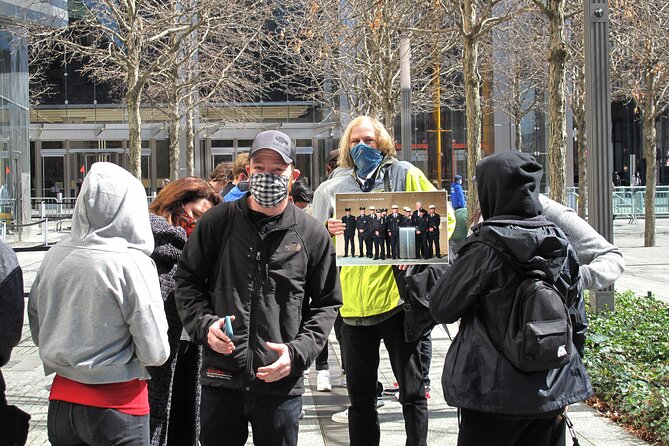
This is the kind of 9/11 experience that respects your time and your emotions. You’re not just collecting landmarks. You’re moving through the Lower Manhattan geography that shaped what people did that day—and you’re doing it with a guide who keeps the story grounded in specific places.
I like that the tour leans hard on visuals. Those large-format historic photos are not decoration. They’re used to help your brain hold onto details while you’re outside, looking at what rebuilt New York looks like now. It helps the day feel less abstract.
The other reason this works so well is structure. You get a guided walking loop first, then the museum portion. By the time you reach the National September 11 Memorial & Museum, you have context for what you’re about to see, and the visit becomes easier to navigate. That matters a lot in a museum where there is a lot to absorb.
You can also read our reviews of more tours and experiences in New York City.



Meet at 20 Dey St: the 4-hour plan (and why timing matters)
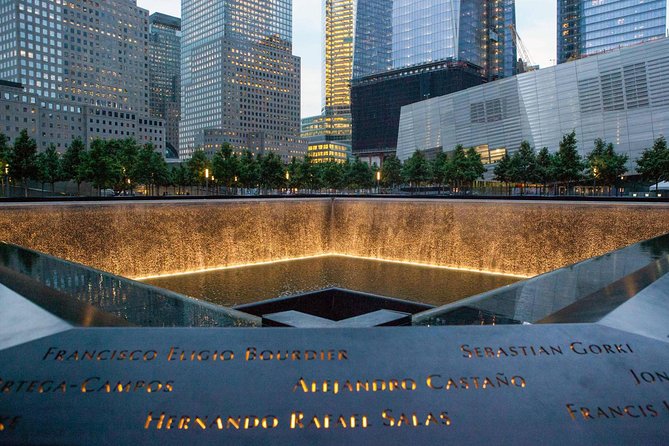
The tour starts at 20 Dey St, New York, NY 10007, and ends inside the 9/11 Memorial complex at 180 Greenwich St. It runs about 4 hours total, with morning and afternoon departures.
That end point is a big deal. Instead of being dumped back on the street after a walk, you’re placed inside the museum area where your next steps are clear. It’s also why the pace feels efficient: you go walking first, then you go inward.
You’ll also appreciate the group size. With a maximum of 25 people, it’s easier to keep together at busy points like the Memorial Plaza. Most days you’re dealing with crowds in the area, but a small group helps you avoid getting swallowed by the neighborhood.
From the Oculus to FDNY stories: the start that sets the tone
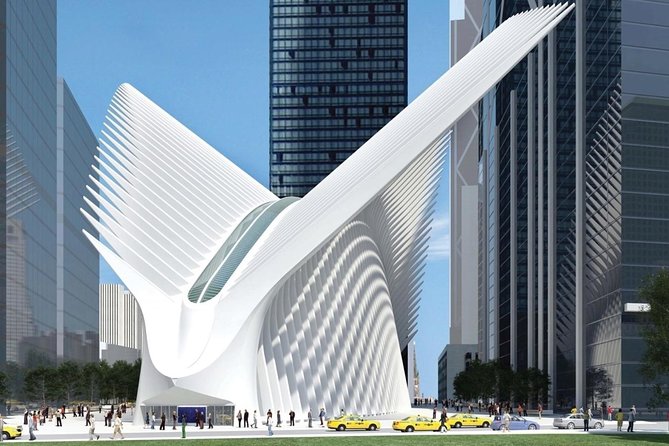
The experience kicks off close to the Oculus, at a Starbucks across the street from it. This matters because the Oculus is not just an architectural moment. It’s a reminder that Lower Manhattan is a transit engine. Before you even get to the memorial, you’re already thinking in terms of movement—who could get where, and how quickly the city adapted.
One standout part of this opening segment is the FDNY connection. The tour introduces Captain John Jonas and his team, the Dragon Fighters. That framing helps you hear what the day sounded like from the perspective of first responders, not just from a headline view.
This first stop is short, which is smart. You’re warming up your attention rather than exhausting it. Then you’re ready for the memorial-area overview.
The memorial plaza overlook: seeing the complex as one picture
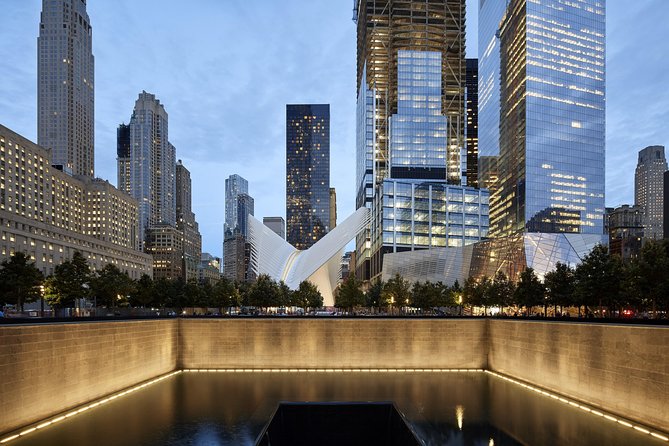
Next you head toward an overlook of the World Trade Center Memorial Plaza. From this vantage, you can take in the whole complex at once: One World Trade Center, the Reflecting Pools, and the 9/11 Museum.
This is where the tour earns its keep for first-timers. If you only visit the site on your own, you can miss how the pieces relate. From an overlook, it becomes much easier to understand what is meant to be connected—what was lost, what was rebuilt, and what now anchors the area.
The time here is generous enough (about 40 minutes) to really look, not just point. You’re also learning stories tied to the places you’re physically seeing, including accounts connected to firefighters and office workers.
Brookfield Place and the Winter Gardens: the surprise chapters
After the plaza area, the walk shifts toward Brookfield Place and the World Financial Center. This is a part of the Lower Manhattan puzzle many people skip because it’s not as instantly recognizable as the memorial itself.
Here’s what makes it memorable: you learn about Operation Aegis, described as the largest rescue by sea in history, where more than 500,000 civilians were evacuated by watercrafts of all sizes. If you’ve mostly heard about land-based routes and rescue scenes, this adds a different angle. It also reminds you that survival isn’t only about what happened at one point. It’s about how evacuation systems worked across the water.
Then you reach the Winter Gardens. This reconstructed glass pavilion was devastated during the attacks, and it’s now a standout space: a 10-story glass pavilion with a price tag of about $60 million in the rebuild. It’s one of those stops where the contrast can feel strange. Glass makes you think light and calm, but the story attached to it is not calm. That tension is part of the lesson.





Eleven Tears Memorial: a focused moment of remembrance

The tour includes a visit to the Eleven Tears Memorial, which is dedicated to the eleven American Express employees lost on that day. This is a calmer pocket compared with some of the louder sightlines around the main complex, and it gives you space to absorb the fact that the tragedy was not one big event. It was many individual lives.
You also get a short, respectful stop that doesn’t rush you. It’s about paying respects and letting meaning land, not about checking a box.
And if you’re the type who likes your memorial time to feel structured, this tour does that well. The guide helps you slow down without turning the visit into a lecture.
World Trade Center complex details: Survivor Tree and Building Four mysteries

As the walk concludes at the new World Trade Center complex, the guide shifts into design-and-construction context. You’ll learn how the new complex was shaped, and you’ll also hear about a mystery: the lost gold and silver reserves of Building Four.
Then comes a stop that almost always sticks with people: the Survivor Tree. This is presented as a symbol of resilience, survival, and rebirth. You’re not just seeing a landmark tree. You’re seeing an idea made physical.
This segment is shorter (around 15 minutes), but it’s designed as a bridge. You go from the stories and the memorial space into the museum portion with a better sense of how everything fits together.
The 9/11 Memorial & Museum: enhanced access, self-paced 2-hour visit
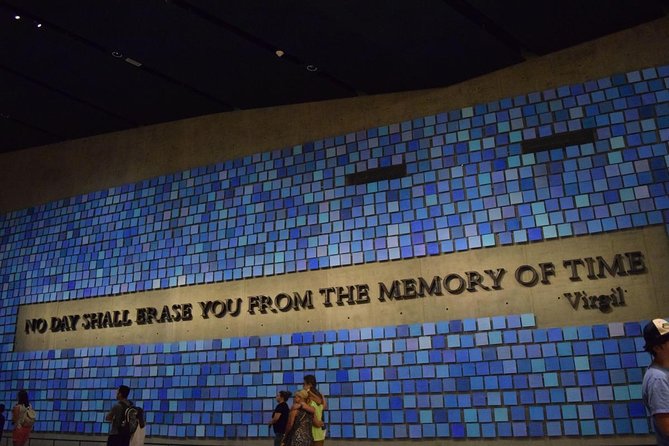
After the walking tour, you get pointers before entering the National September 11 Memorial & Museum. The aim is practical: help you optimize what to focus on so you don’t spend your energy stuck in lines of decision-making.
The museum time is about 2 hours, and it’s self-guided after the guide gives you highlights. That approach is a good match for different visitors. If you need more time at certain artifacts or prefer to watch first-person videos slowly, you can. If you want to hit key themes and move on, you can do that too.
This visit includes multiple artifacts and first-person videos from survivors and rescuers. The museum’s structure rewards that mix. You get emotion, but you also get specific details that help your understanding hold together.
One important logistics note: the museum has a no reentry policy. So once you’re inside, it’s smart to treat the 2-hour window like a true visit block, not a “drop in and out” plan. The tour’s enhanced access is meant to keep the day moving, but the visit itself still takes time.
One World Observatory: the 102-story view after the memorial
After the museum, the offer includes skip-the-line access for One World Observatory. The payoff is the view from 102 stories above street level—an angle on the city that can feel oddly emotional after Lower Manhattan’s heavy context.
This is also a scheduling advantage. Instead of you figuring out the best time to return to the observatory, you can build it into the same overall arc of the day. If you’re trying to see New York efficiently, it’s a nice way to end on a different sensory note: height, distance, and city lights instead of memorial walls.
Price and value: is $79.95 fair for what you get?
At $79.95 per person for about 4 hours, this tour isn’t cheap in the way that a basic walking tour might be. But it’s also not just a narration service.
You’re paying for three things that add value:
- A guided walking loop that covers multiple meaningful stops.
- 9/11 Museum enhanced access with skip-the-ticket-line entry included.
- A built-in follow-on with skip-the-line access to One World Observatory and its 102-story views.
That combination is where the value lands. If you tried to piece this together on your own, you’d spend time coordinating tickets, timing entry windows, and figuring out what order makes the most sense. Here, the tour does that planning for you.
It also includes large 11×17 photos in the narration, which may sound like a small detail until you’re watching history become visual in front of you. Big images help people process faster and remember longer.
Who should book this tour?
This is a strong fit if you:
- want a guided structure through the site rather than a free-for-all,
- care about understanding both the immediate response stories and the rebuilt landscape,
- like photos and clear pacing instead of a purely word-based tour,
- want a one-day plan that wraps in the museum and then the observatory.
It’s also a decent pick for families and groups, with a controlled group size and a pace that doesn’t feel like a sprint.
A few practical tips before you go
Keep your expectations realistic. The museum portion alone takes about 2 hours, and it includes serious material. If you also plan the One World Observatory visit, treat the full day like a commitment.
Also, check your email for your mobile ticket. One mixed report involved trouble with museum entry when a code did not arrive as expected. The helpful fix in that case was contacting support or letting the guide know quickly—so if anything looks off, don’t wait until you’re standing at the entrance.
Should you book this preferred-access Ground Zero tour?
If you want an efficient, respectful way to learn the 9/11 story while seeing what changed, I think this is an easy yes. The walking segment gives you orientation. The museum block then gives you depth, and you’re set up to use your time inside rather than guessing your way through.
I would skip it only if you want total freedom—no structure at all—or if you already know the key history and you simply want to walk the grounds with no guided context. Otherwise, the combination of guided walking, enhanced museum access, and One World skip-the-line value makes a lot of sense.
One more reason I’d lean toward booking: the guides often bring personal perspective that helps the day feel real. Names highlighted include David, Alex, Christopher, Kevin, Richard, Mark, Bobby, Raymond, Andrew, and Keith, and that variety can make it easier to find a style that matches your preferences.
FAQ
How long is the tour?
It runs about 4 hours in total.
How much does it cost?
The price is $79.95 per person.
What language is the tour offered in?
The tour is offered in English.
Where does the tour start and end?
It starts at 20 Dey St, New York, NY 10007, and ends inside the 9/11 Memorial at 180 Greenwich St, New York, NY 10006.
Does the price include admission to the 9/11 Memorial & Museum?
Yes. The 9/11 Museum admission is included in the cost, and you also get skip-the-ticket-line access.
Is the museum visit guided?
You get guidance and highlights before you enter, but the museum itself is self-guided so you can explore at your own pace.
Is there time to visit One World Observatory after the memorial?
Yes. The experience includes skip-the-line access to One World Observatory with views from 102 stories above street level.
How big is the group?
The tour has a maximum of 25 travelers.
Can I get a mobile ticket, and is confirmation provided?
You receive a mobile ticket, and you’ll receive confirmation at the time of booking.
What is the cancellation window?
Free cancellation is available up to 24 hours in advance for a full refund.