REVIEW · BOSTON
Boston History Tour: Scenic Walk Through Time & Landmarks
Book on Viator →Operated by Intrepid Urban Adventures - USA · Bookable on Viator
Boston history is close-up and on your feet. This smart little walk threads through Faneuil Hall, Old State House, and the Public Garden, with a guide who connects big moments to the street corners you can actually see. Two things I really like about it are the small-group pace (you can ask questions) and the built-in “what does this mean today?” lens. The main drawback to consider: parts of the route pass through busy downtown retail streets, so if you want total quiet and zero foot-traffic, plan your expectations.
I also like the practical, first-timer-friendly setup. You start at the Greenway Carousel by Rose Kennedy Greenway and finish near Boston Public Garden, with a clear arc from Revolution-era power to modern city life. Guides such as Bob, Nabil, Alivia, Lexie, and Tim are repeatedly praised for wit and keeping everyone engaged, which matters on a 4 km (2.5-mile) stroll.
In This Review
- Key points you’ll care about
- Why this Boston walking loop works for first-timers
- Rose Kennedy Greenway start: a calm warm-up before the heavy history
- Faneuil Hall to Custom House Tower: revolution talk meets trading city reality
- Old South Meeting House and the Tea Party planning vibe
- Boston’s print and ideas: the first bookstore site on your path
- Old City Hall, the Bronze Donkey, and the sound of King’s Chapel
- Old State House to Boston Common: where government and public space meet
- Beacon Hill’s cobbled streets and the Robert Gould Shaw Memorial
- Massachusetts State House: the dome, the people, and the cornerstone ceremony
- Granary Burying Ground: Revolutionary leaders in a 1660 cemetery
- Boston Public Garden ending: first public park energy
- Price and value for $39.80: what you get beyond the walk
- Who this tour is best for (and who may not love it)
- FAQ
- How long is the Boston history walking tour?
- What does the tour cost?
- Is this a small group tour?
- How much walking is involved?
- Where do I meet and where does it end?
- Is the tour guided and in English?
- Are there child discounts or free entry for young kids?
- Does the tour run in bad weather?
- What’s included with the tour besides the guide?
- Should you book this Boston History Tour?
Key points you’ll care about
- Small group (max 16): easier questions, less waiting around.
- 4 km / 2.5 miles total walking: doable for most people, but wear real shoes.
- Big landmarks, short stops: you get context without marathon pacing.
- Surprise local treat: sometimes alcohol may be offered, so bring ID.
- Carbon-neutral, B Corp operated: good for your conscience while you tour.
- Ends at the Public Garden: a nice landing spot to keep exploring after.
Why this Boston walking loop works for first-timers
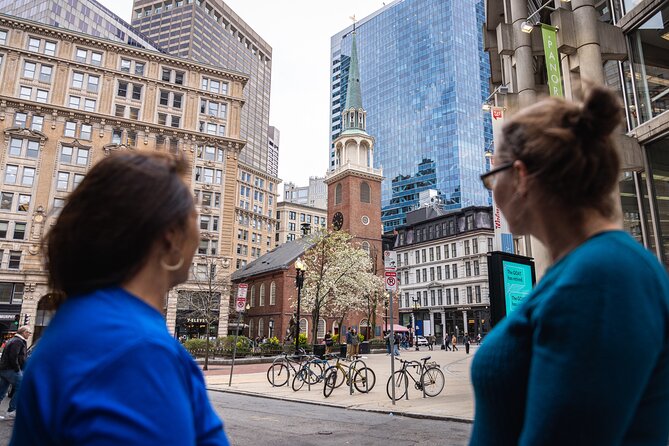
Boston rewards people who know what to look for. This tour helps you do that fast. Instead of trying to “Freedom Trail everything” on your own, you follow a guide who ties together government, commerce, religion, and public space in a way that makes the city feel logical.
The route also hits a great mix of famous and slightly under-the-radar stops. You’ll see the headline names, but you’ll also get pointed to places that make Boston feel lived-in: meeting houses, old civic buildings, and cemeteries where the Revolution’s leaders are actually buried.
One more real-world win: it’s only about two hours. You still have energy for lunch, museums, or ducking into a neighborhood stroll right after.
You can also read our reviews of more tours and experiences in Boston.


Rose Kennedy Greenway start: a calm warm-up before the heavy history
You meet at the Greenway Carousel, 191 Atlantic Ave, right by the Rose Kennedy Greenway. That first stretch works as a mental warm-up. Before you hit the Revolutionary hotspots, you’re walking on a smoother, more open section of downtown where it’s easier to orient yourself.
This area is also a hint about Boston’s modern personality. The Greenway is part park, part public space, and part reminder that the waterfront and downtown have kept changing. That theme matters later when you move from old civic halls to the Massachusetts State House dome and then finish in the Public Garden.
If you like starting tours early in the day (and you should, to beat crowds), this one is a good fit because it doesn’t immediately toss you into a maze.
Faneuil Hall to Custom House Tower: revolution talk meets trading city reality
You kick off with Faneuil Hall Marketplace, a cornerstone of Boston’s independence story. Your guide focuses on the revolutionaries who pushed for independence from Great Britain, and the tone here is usually energized: this is where civic arguments became action.
From there, you can see Custom House Tower. That view comes with a useful detail: it was Boston’s first skyscraper, and it originally had a storage role for incoming goods. That’s a smart pairing. You’re not only learning about rebellion; you’re learning about the commercial machine that made the conflict possible.
You’ll also pick up a practical downtown rhythm for later: where the major foot-traffic routes flow, how to move between major stops, and where Quincy Market and the marketplace vibe sit in the middle of everything. If you plan to shop or grab chow after, you’ll understand the layout much better.
Potential downside to keep in mind: downtown shopping areas show up along the way. It’s not a deal-breaker, but if you’re the type who wants every minute inside quiet history zones, you may wish for more pauses away from storefront crowds.
Old South Meeting House and the Tea Party planning vibe
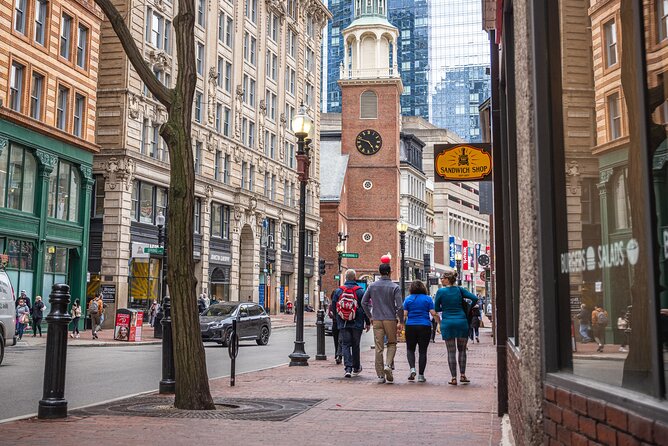
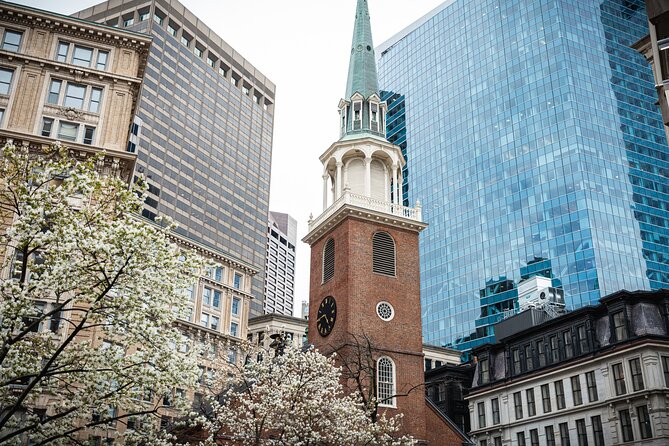
Next up is Old South Meeting House, a former church tied closely to the Boston Tea Party. This stop is short, so the value is in how the guide frames it: who gathered, how planning worked, and why the argument about No taxation without representation landed so hard.
This is also a good stop for history pattern-spotters. You’ll notice the way Boston’s public meeting spaces served as stages for political action. That helps connect the dots to later stops like the Old State House, where big announcements weren’t just speeches—they were civic events.
If you’re coming with questions like who did what and when, this is a strong “foundation” moment. You’ll leave with a clearer storyline rather than a list of dates.
Boston’s print and ideas: the first bookstore site on your path
As you move forward, you pass the site of Boston’s first bookstore. This isn’t just a fun footnote. The point is cultural power: publishing shaped what people read, debated, and repeated.
Your guide ties this spot to major American literature—Thoreau’s Walden, Hawthorne’s The Scarlet Letter, and Longfellow’s Paul Revere’s Midnight Ride. Even if you’re not a “book history” person, the takeaway is easy: Boston wasn’t only a battlefield of ideas. It was also a production center for the ideas that traveled.
This is the kind of stop that works especially well if you’re pairing the walking tour with a museum day afterward, because it gives you more “why does this matter?” background.




Old City Hall, the Bronze Donkey, and the sound of King’s Chapel
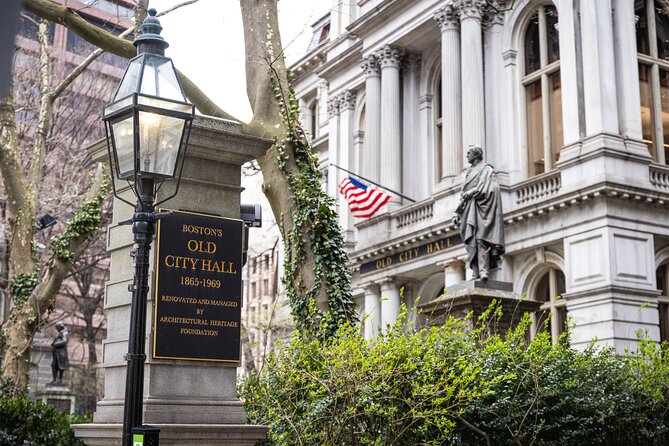
Old City Hall is next, and it’s one of those stops where you can actually feel the layered identity of the city. The hall housed the city council and America’s first public school, so it’s about education and civic governance in one place.
You’ll admire the French architecture and get a photo moment with the Bronze Donkey. That small detail matters because it keeps you grounded in the human scale of the city, not only its monument scale.
From there, you pass through Downtown Crossing and head toward King’s Chapel. If you’re lucky, you might hear the organist. There’s a reason that’s a big deal: King’s Chapel has what’s described as the oldest church organ in the US. Even catching a short piece of music can make the building feel less like a stop and more like a living place.
Practical note: because this is downtown, you’ll want to keep your phone/hat close and your attention on where the group is heading. Your guide will keep you moving, but sidewalks and intersections can get crowded fast.
Old State House to Boston Common: where government and public space meet
Old State House is one of the most powerful stops on the walk. This is where the Declaration of Independence was announced in 1776. Your guide also balances the excitement of that moment with the tragic Boston Massacre.
That contrast is the whole point. Boston’s Revolutionary story isn’t just heroes and speeches. It includes fear, anger, and real consequences in the streets.
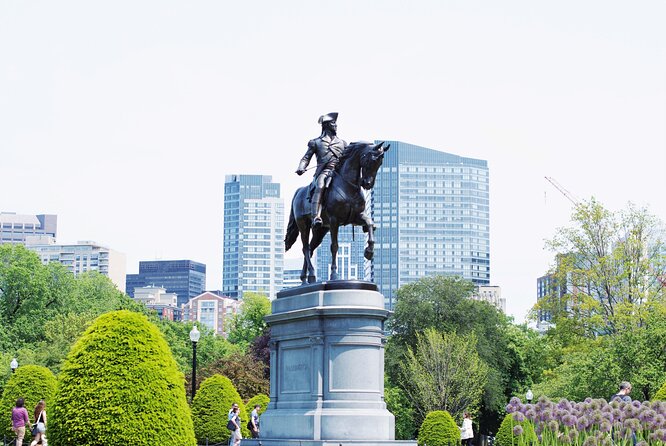
Then you move into Boston Common, the oldest city park in the US. You’ll walk through memorials, fountains, and recreation areas with roots stretching back to 1634. It’s a reminder that Boston’s “public life” didn’t start in the 1900s or only in the colonies. The park model is part of the city’s DNA.
If you’re the kind of person who loves connecting places to people’s daily routines, Boston Common is perfect. It’s not only about what happened. It’s about what’s still happening—right there.
Beacon Hill’s cobbled streets and the Robert Gould Shaw Memorial
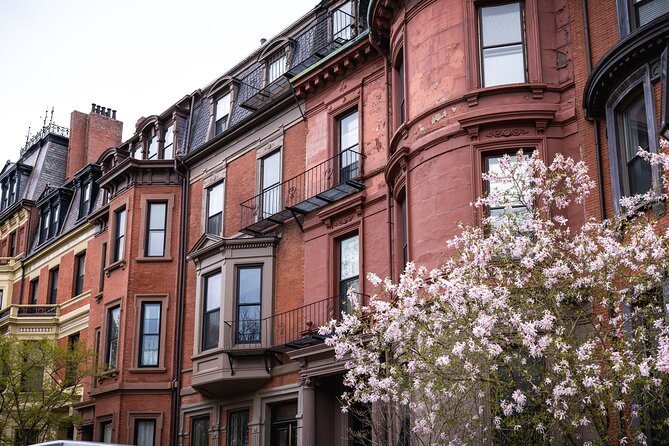
One of Boston’s most recognizable neighborhoods shows up next: Beacon Hill. You’ll hear how the area once declined due to sailors and British soldiers, then how it became the iconic district it is today. The cobbled streets help you understand why the neighborhood has such a strong “you’re there” feel.
Then you’ll stop at a memorial with major meaning: the Robert Gould Shaw Memorial. This is tied to one of the first African American regiments in the Civil War, and to its colonel, Robert Gould Shaw.
This stop is brief, but it’s important because it widens the scope. You’re not only learning Revolution-era political conflict. You’re also learning how Boston’s story connects to later battles for freedom and representation.
Massachusetts State House: the dome, the people, and the cornerstone ceremony
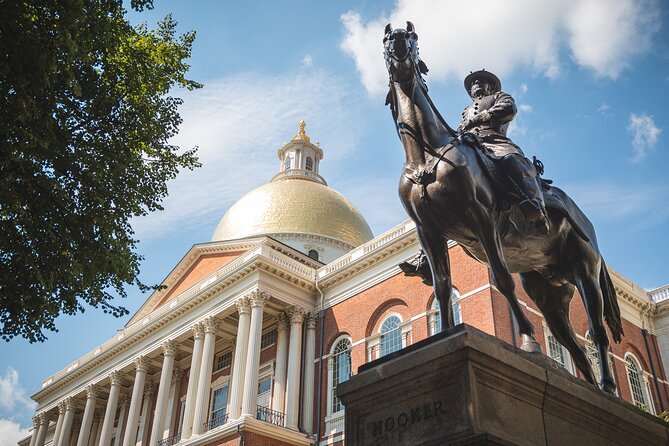
The tour reaches the Massachusetts State House and its glittering dome. This is a classic Boston “wow” moment, but it comes with specifics that help you look smarter.
Your guide talks about John Hancock as the original landowner and Paul Revere’s role in the 1795 cornerstone ceremony, where he presided. That detail matters because it links Revolution-era identities to the building of state power.
It also helps you notice something about Boston: history isn’t stuck behind glass. It’s built into the skyline and still used as a working government space.
If you time your day right, this stop pairs well with a later self-guided walk around nearby streets, because your sense of direction improves after seeing how the State House sits in the city.
Granary Burying Ground: Revolutionary leaders in a 1660 cemetery
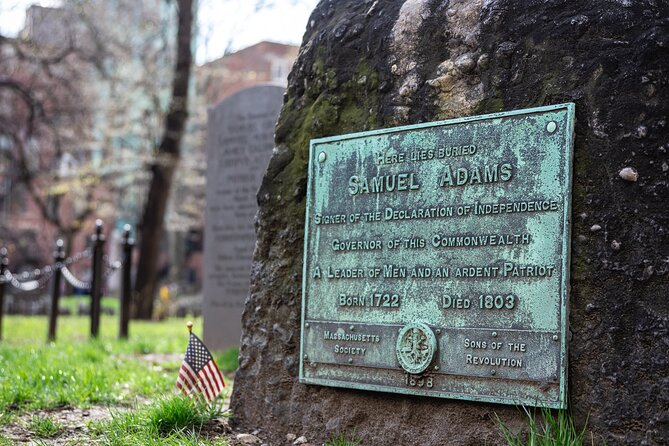
Next is Granary Burying Ground. It dates back to 1660 and was originally part of Boston Common. Your guide points out famous Revolutionary figures buried here—John Hancock, Paul Revere, and Sam Adams.
This stop is where the tour becomes emotional in a good way. It’s one thing to hear about leaders in a classroom voice. It’s another to stand near the names and realize these people were literally set into the city’s ground.
If you care about symbolism, you’ll also appreciate the “continuity” angle: Revolutionary memory kept its home close to where public life happens.
One practical thought: cemetery access can vary based on day-to-day conditions and the flow of visitors. Your guide can adjust the route if needed, since changes to the route and places visited can happen.
Boston Public Garden ending: first public park energy
You finish at Boston Public Garden, near 4 Charles St. It’s described as the first public park in America, and you’ll walk through it like a local would: people moving at an easy pace, taking breaks, letting the city noise soften.
Your guide shares how the park has been used during the Revolution and beyond. That adds a nice wrap-up to the tour’s theme: public spaces in Boston have always been part of civic life.
When the tour ends here, it’s a smart finish. You’re not stuck back in a high-traffic transit node. You’re dropped into a calm spot where you can plan the rest of your day: relaxing, grabbing nearby food, or continuing on foot.
Price and value for $39.80: what you get beyond the walk
At $39.80 per person for about two hours, this tour is priced for real value. You’re paying for three things that are hard to DIY: pacing, storytelling, and setup.
First, pacing. Four kilometers (2.5 miles) is not too much, but it adds up. Having a guide manage timing means you don’t waste time wandering between “important” places that aren’t actually on your path.
Second, storytelling. The guide connects meetings, government, printing, and public parks into one coherent storyline. That makes the sites more memorable than a quick photo stop.
Third, inclusions. You get a surprise local treat, and the tour is run by a B Corp-certified company using travel as a force for good with carbon-neutral operations. Even if you skip alcohol (alcohol might be served and ID may be required), the “local treat” still feels like a small bonus that helps you transition from history mode to city mode.
For timing, it’s often booked around 28 days in advance. If you’re visiting during peak season or on a weekend, it’s wise to lock in sooner rather than later.
Who this tour is best for (and who may not love it)
I’d point you to this tour if you want an easy way to get your bearings on a first visit. It’s especially good for people who like guided context and don’t want to spend the first day building their own route.
It’s also a strong choice for couples and families, since it’s child-friendly. Children under 6 can join for free, and kids 6 to 11 join at the adult rate. If you’re traveling with children, add their age info at booking so the group is sized correctly.
Private upgrade option is worth noting if you want more one-on-one questions or a slower rhythm. Small-group tours are great, but a private tour can feel better when your interests are very specific.
Who might not love it: if you want a strictly “no shopping streets” walk, you may feel the route is too urban for your taste. And if you hate any walking at all, remember you’re covering about 4 km. Bring shoes you can walk in for real.
FAQ
How long is the Boston history walking tour?
It runs about 2 hours.
What does the tour cost?
The price is $39.80 per person.
Is this a small group tour?
Yes. The maximum group size is 16 travelers.
How much walking is involved?
The tour covers about 4 km (2.5 miles).
Where do I meet and where does it end?
You start at the Greenway Carousel at 191 Atlantic Ave, Boston. The tour ends near Boston Public Garden at 4 Charles St.
Is the tour guided and in English?
Yes, it includes an expert English-speaking guide with local insights.
Are there child discounts or free entry for young kids?
Children under 6 can join for free. Children aged 6 to 11 can join at the adult rate, and you should note the child details at booking.
Does the tour run in bad weather?
Yes. Experiences happen rain, shine, or snow, so dress for the conditions.
What’s included with the tour besides the guide?
You get the guided tour plus a surprise local treat. Alcohol might be served, and proper ID may be required.
Should you book this Boston History Tour?
Yes, if you want a smart first-pass through Boston that still feels human at street level. You’ll get a guided storyline from Revolutionary landmarks to modern public spaces, plus a local treat and insider tips, without committing your whole day to planning.
Skip it only if your top priority is quiet, museum-like history time with minimal downtown foot-traffic. If that’s not you, this is a solid way to understand Boston fast, then spend the rest of your trip exploring with better eyes.